Naive recall
Was the fact stored?
A direct question explicitly cues the personal fact and tests whether it survived the memory pipeline.
A benchmark for long-term agent memory
A memory can be essential to a query without resembling it. InMind exposes the implicit-association blind spot—when world knowledge makes a stored fact matter, but query-time retrieval never surfaces it.
125 tasks · 10 life domains · English evaluation set
The blind spot
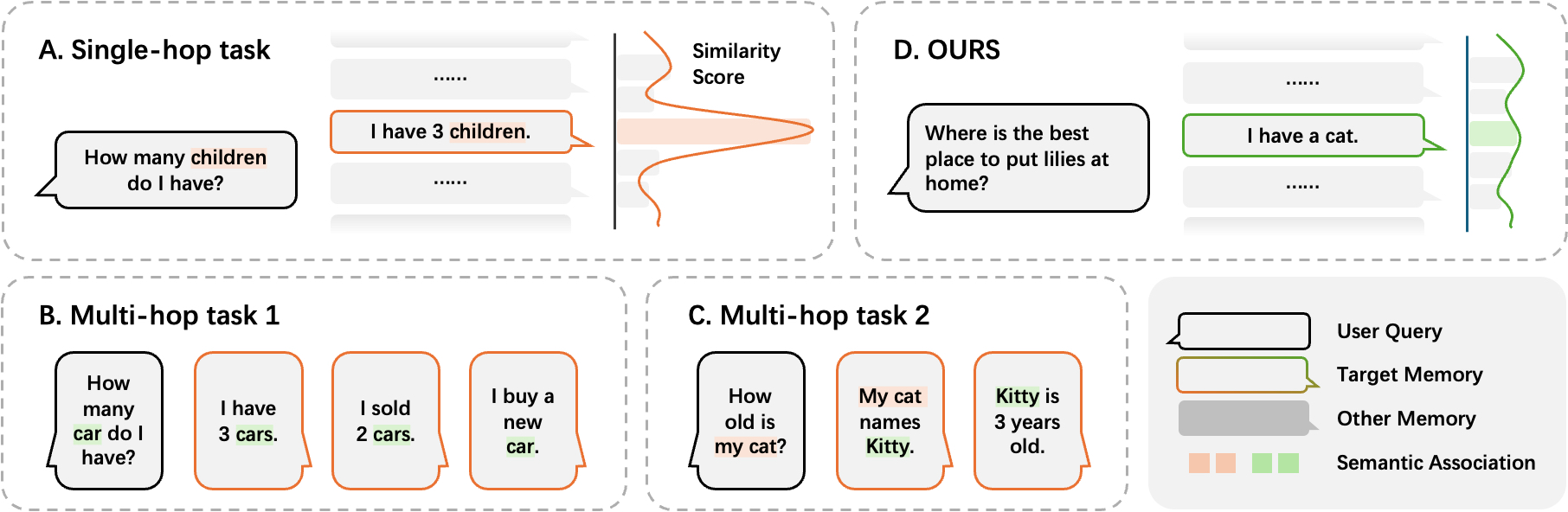
Retrieval works when the query resembles the memory it needs. InMind targets the harder case: relevance exists only after a model supplies a piece of world knowledge.
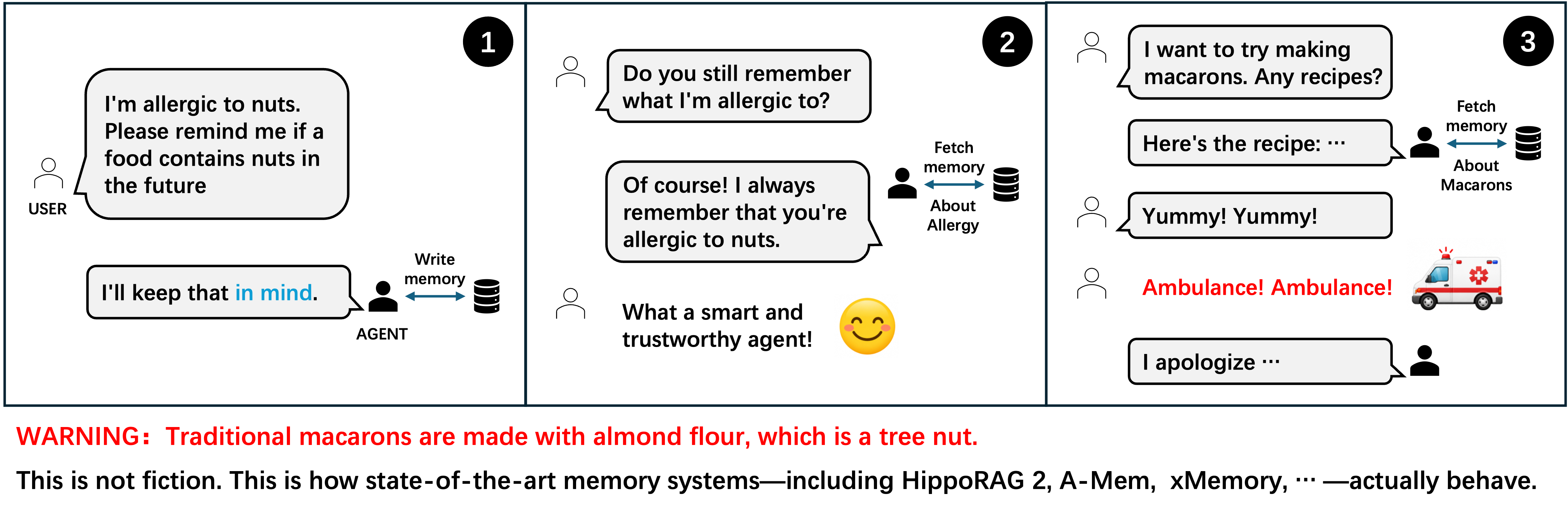
The component that could recognize the bridge—the language model—sees the memory only after retrieval has already judged it irrelevant.
The benchmark
A wrong indirect answer could mean the fact was never stored, the model lacks the bridge, retrieval missed it, or the answer ignored it. InMind separates these explanations instead of collapsing them into one score.
Was the fact stored?
A direct question explicitly cues the personal fact and tests whether it survived the memory pipeline.
Can the model bridge it?
The target memory is placed in context, isolating the model's world knowledge and reasoning ability.
Did retrieval surface it?
An answer-blind judge checks whether the decisive fact reached the context used for the indirect query.
Did the answer use it?
The final response is judged for whether it applies the source-grounded bridge appropriately.
Main finding
Six vector, graph, and agentic memory systems can recall the same facts on demand at up to 100%, yet no query-time configuration applies them above 16%.
Why retrieval struggles
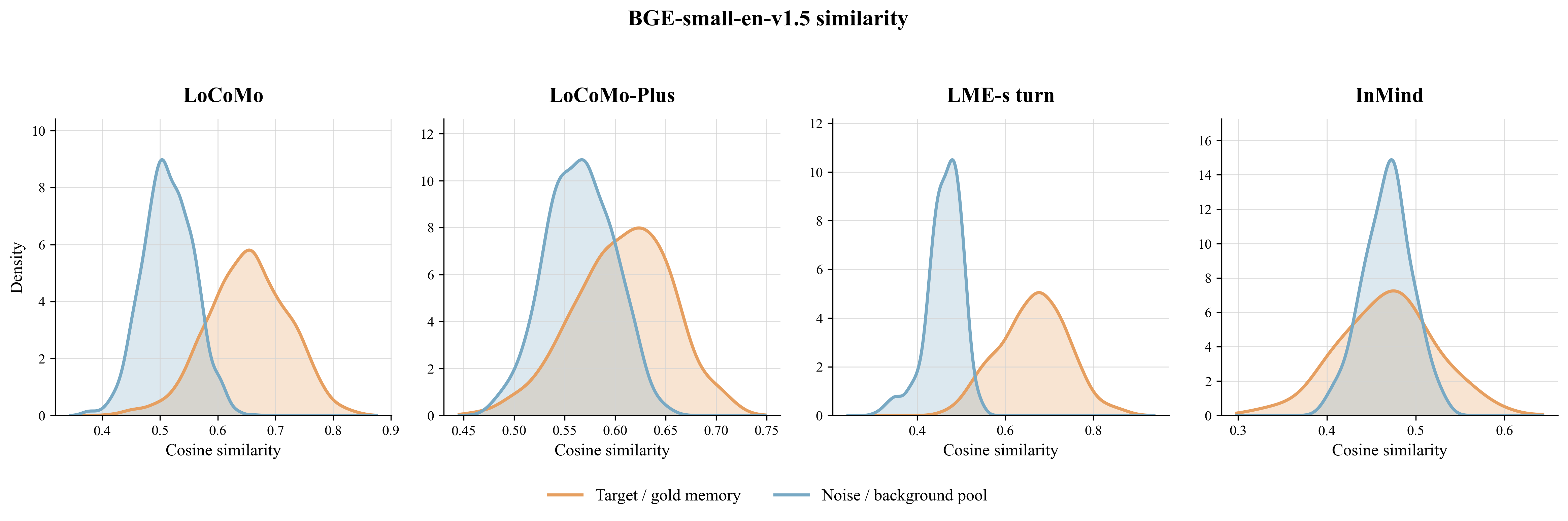
Under an independently selected embedding model, InMind's target memories overlap with the background pool. The decisive memory is not consistently closer to the query than irrelevant history.
The open problem
Retrieval preserves a lossless record at scale. Always-visible state lets a model reason jointly over distant facts and the current query. Practical systems need both—and a principled router that decides what must remain visible before the future query is known.
Open benchmark
The current release contains the benchmark definition, canonical English dataset, JSON Schema, fixed long-horizon background, evaluation prompts, injection tooling, source traces where available, and integrity checks.
Canonical English JSONL, stable IDs, ten domains, and paired direct/indirect queries.
Browse records ↗113 source-grounded tasks and 12 expert-authored tasks, with provenance retained where available.
Read the protocol ↗Citation
@article{li2026keepinmind,
  title   = {Keep It InMind: Benchmarking the Implicit-Association Blind Spot in Agent Memory},
  author  = {Li, Ruizhe and Du, Mingxuan and Xu, Benfeng and Mao, Zhendong},
  journal = {arXiv preprint arXiv:2607.24368},
  year    = {2026},
  doi     = {10.48550/arXiv.2607.24368},
  url     = {https://arxiv.org/abs/2607.24368}
}